Signs that your Trees are Planted Too Deep.
Your trees might look apparently happy and present no obvious damage. But take a closer look, they may be showing signs of stress due to deep planting.
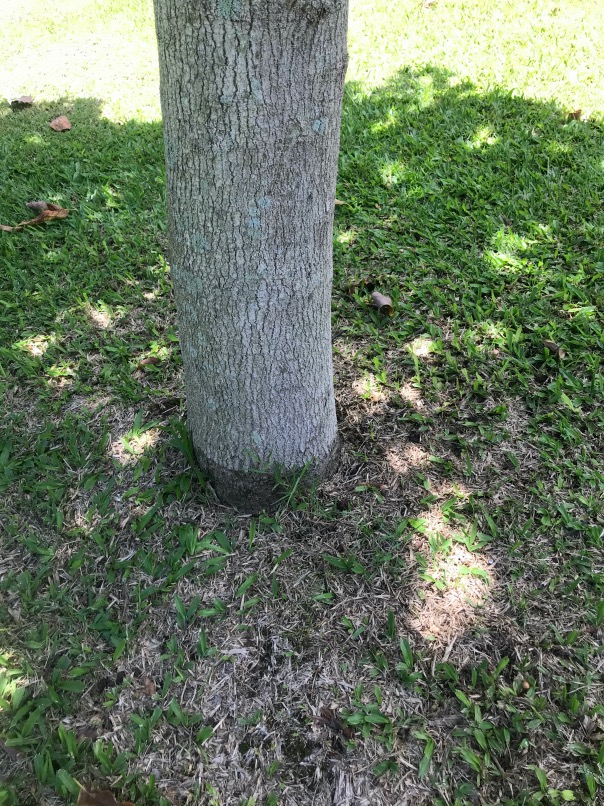
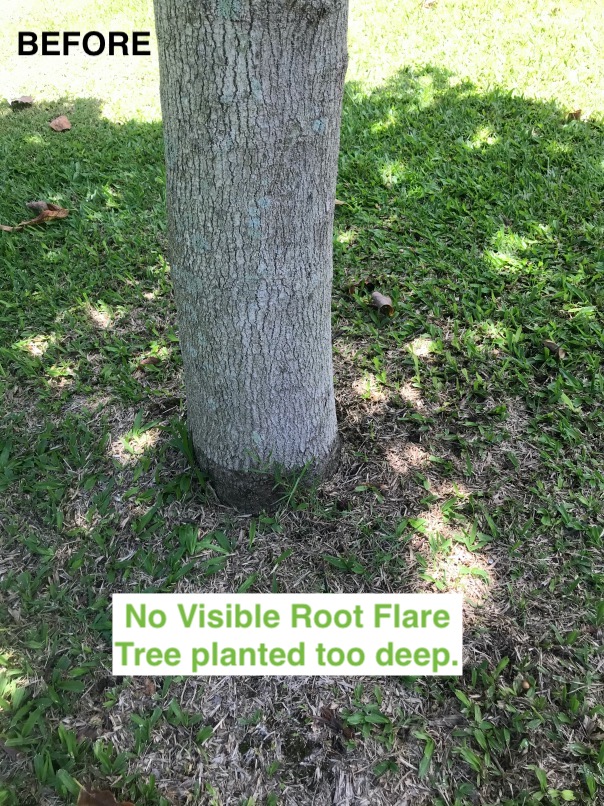
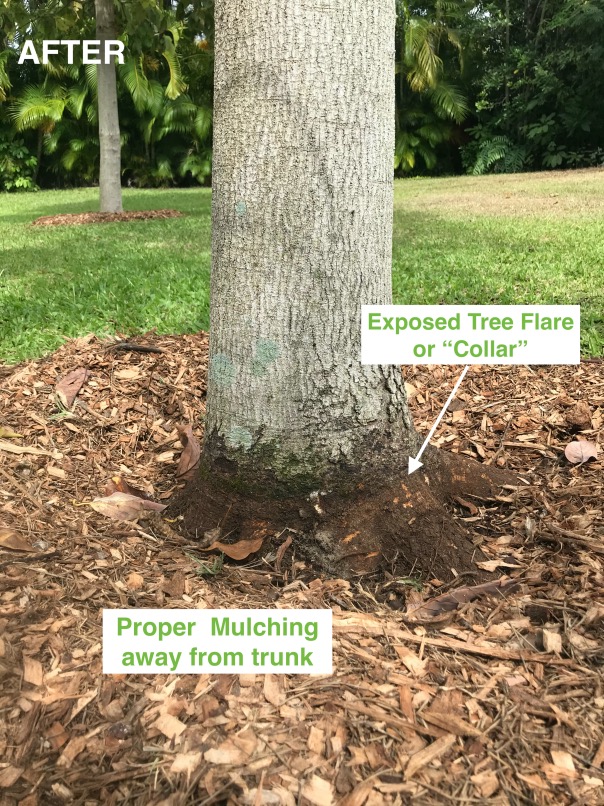
First observe the tree trunk where it meets the ground. It should be tapered out and showing some roots. Trees with well-defined root collars were planted at the correct depth. If you see a straight pole-like trunk going in the ground, it's probably planted too deep.
Other symptoms of trees planted to deep in the landscape may include:
- Reduced growth rate
- Dwarfed leaf size and/or defoliation
- Yellowing (often mistaken for poor soil nutrition)
- Bark splitting
- Increased susceptibility to borers
- Girdling roots
- Branch dieback
- Eventual tree death
Tree Planting Tips.
Here's some tips to consider when planting a tree:
- The trunk flare is where the trunk expands at the base of the tree. Ensure trunk flare is partially visible after the tree is planted. Most nursery grown trees are planted too deep and the flare is not visible. Remove excess soil and expose the tree collar prior to planting .
- If it has a burlap , also make sure to take it off before planting the tree.
- Dig a planting hole 2–3 times wider than the root ball, but only as deep as the root ball.
- If wrapped, remove any cover, even burlap, from around the root ball and trunk to facilitate root growth.
- Place the tree at the proper height. The root flare should be exposed, at or above ground level.
- Straighten the tree in the hole.
- Pack soil around the base of the root ball to stabilize it.
- Mulch the base of the tree. Do not to pile mulch right against the trunk. Leave a mulch-free area of 1–2 inches.
- Water frequently, at least once a week depending on weather. Keep moist but not soggy.
- Provide follow-up care. Consult your local ISA Certified Arborist® for professional tree care.
Correcting Deep Planting.
If the tree is young and has been recently planted, replant at the proper depth. When transplanting, remove the excess soil and any surface roots growing above the root flare. Don't dig the hole deeper than the height of the root ball, it's better a 1-2 inches higher than the surrounding ground than burring it too deep.
For more mature, established trees you will need to remove the soil around the root flare to expose the collar. Carefully remove the excess mulch or soil from the circumference of the trunk to the point where the trunk flares out into root growth. Arborists can perform root collar excavation by using an air spade, a special tool powered by an air compressor, which causes minimal root disturbance.
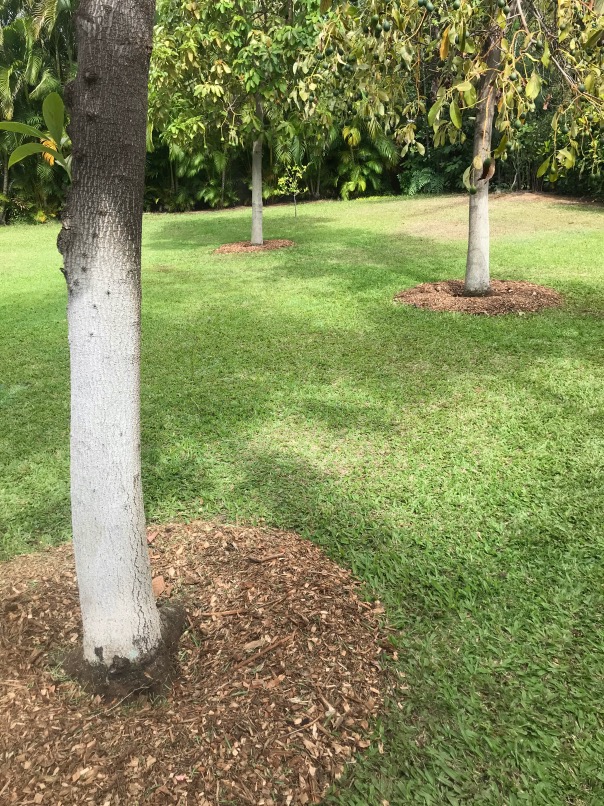
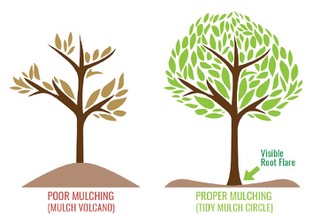
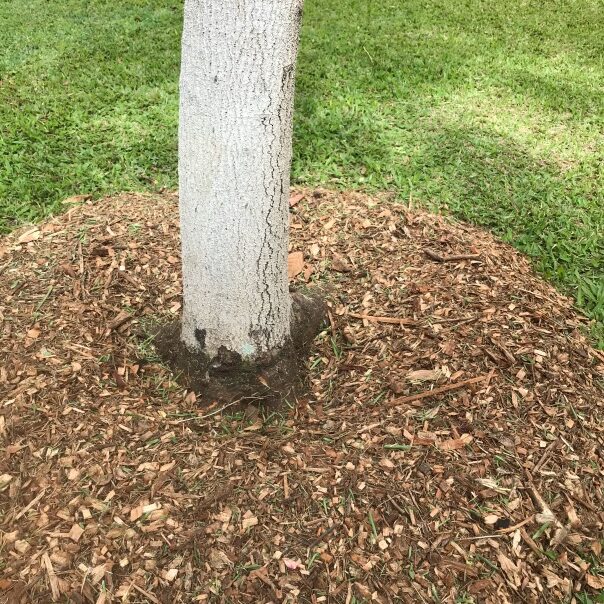
Correcting Over-Mulching aka "Volcano-Mulching"
“Volcano mulching” is when a mulch pile is covering the trunk of the tree. This has the same negative impacts as planting too deep.
If you observe that your trees have mulch covering the base of the trunk, remove the mulch from around the base of the tree, it should never be touching the trunk. Always maintain a separation of at least 6" mulch-free.
Spread a thin layer of mulch each year, allowing the previous mulch to break down before applying more. A 1-2 inch layer of fine mulch or 3-4 inches layer for a coarser material. Too much of either type can suffocate your plants. If the mulch application is too thick it can have the same effect as planting too deep
Important Definitions:
- Root Collar or Root Flare: the area where the roots join the main stem or trunk. This area is where the trunk flares out and enters the soil then transitions into the major roots. The root collar is part of the tree's trunk. This area at the base of a tree where the trunk transitions from trunk and bark tissues into root system tissues. Roots should be growing outward from the base of a tree at the same level as the surrounding soil or slightly above it.
- Mulch: It's a layer of material applied to the surface of soil. Reasons for applying mulch include conservation of soil moisture, improving fertility and health of the soil, reducing weed growth and enhancing the visual appeal of the area. A mulch is usually, but not exclusively, organic in nature. Mulch is most commonly made of tree bark, wood chips, pine straw, moss, grass clippings, or leaves.
- Girdling Root: lateral roots that emerge at or slightly below the soil surface and cut into at least one side of the main trunk. These roots restrict the movement of water and nutrients to the leaves as they put pressure on the trunk. The most common theory of the cause of stem girdling roots, is that they develop as a result of trees being planted too deeply.
If your tees are dealing with this or any other issues, we can help!
ClimbingHI Tree Services can developed a custom Plant Health Care program to keep your trees happy and healthy.