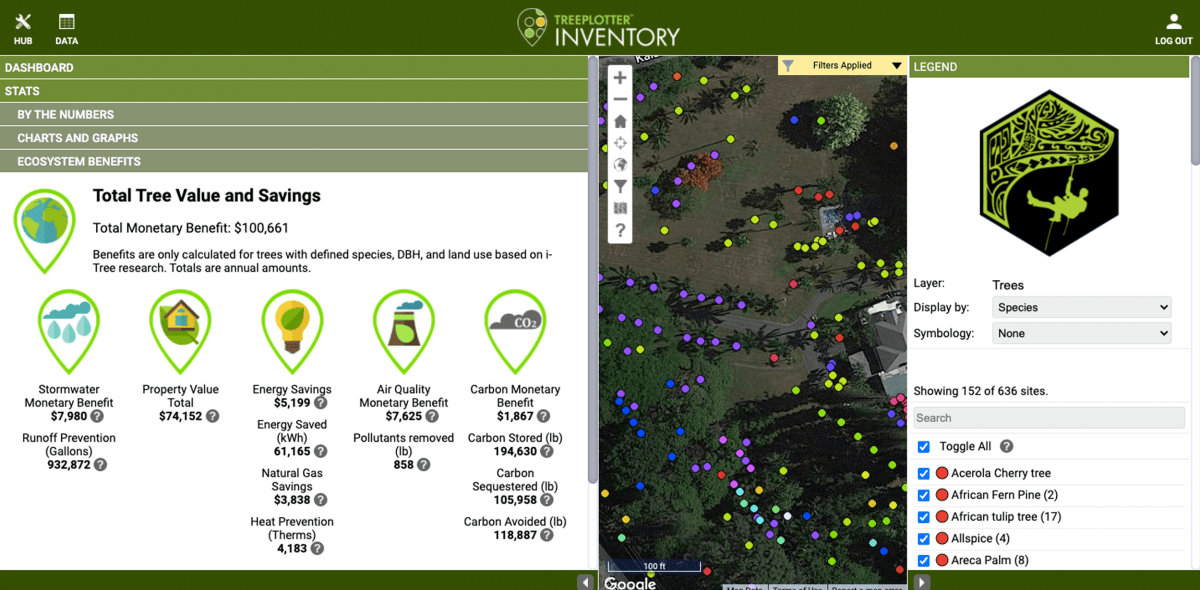
TreePlotter™ has many useful tools, but one that stands out is the ability to estimate ecological benefits of trees in a monetary USD value.
With tree species, DBH (diameter at breast height), and land use data, the software estimates the ecological benefit that trees provide to the owner and the community.
This is done through the National Tree Benefit calculator, an online tool based on i-Tree Streets research.

5 Categories of Eco-Benefits of Trees

Trees Reduce Stormwater
Stormwater: Through promoting healthy soil and intercepting rainfall, trees help to reduce the amount of stormwater created from a rainstorm. Results are shown both in gallons of stormwater and an estimated monetary benefit, in USD.

Trees Increase Property Value
Property Value: Studies have shown that trees increase the value of the property they’re on. This model uses the tree’s leaf surface area and the number of trees on the property . It estimates the increase to property value in USD that they provide. These values can expect to increase over time as long as the trees are healthy and growing in leaf surface area.

Trees Increase Air Quality
Air Quality: Trees help to absorb harmful pollutants, intercept particulate matter that can cause respiratory issues and release oxygen into the air. These benefits are recorded as estimates of pollutants removed. The following pollutants are included: Ozone (O3) , Volatile Organic Compounds (VOC) , Nitrogen Dioxide (NO2), Sulfur Dioxide (SO2) , Particulate Matter

Trees Provide Energy Savings
Energy Savings: Shows energy saved due to the presence of trees. It's estimated in kilowatt/hour, therms and in USD. Shading in the summer helps to reduce air conditioning costs. Trees transpire water, adding to the moisture content in the air and reducing air temperatures. Tree canopies serve as wind blocks, reducing the loss of heat through surfaces like glass windows.

Trees Reduce Carbon Dioxide
Carbon Dioxide / Carbon Storage: A healthy tree canopy helps to reduce atmospheric carbon through carbon sequestration. This means pulling carbon dioxide from the air and storing in their roots, trunks, stems and leaves. Energy savings also contribute indirectly to a decrease in carbon dioxide by lessening the need for air conditioning and heating.
Some important definitions:
- Carbon Stored: All carbon dioxide stored in the urban forest over the life of the trees as a result of sequestration (in pounds). This measurement is not the same as annual carbon sequestered.
- Carbon Sequestered: The amount of carbon annually removed from the atmosphere and stored in the canopy’s biomass (in pounds).
- Carbon Avoided: Annual reductions in atmospheric CO2 due to sequestration by trees and reduced emissions from power plants due to reduced energy use (in pounds).
The time is now for humanity to understand the importance of trees and ecosystems around them.
With technology like TreePlotter™ and its eco-benefits, the general public can become educated on the value of the natural world around them, accessible at their fingertips!
The tree data that ClimbingHI Tree Services is collecting, there will be valuable findings about Maui’s tree inventory and ecosystems in the future.